
项目介绍
NanoMesh
Distributed AI Orchestration System and Heterogeneous Micro-Model Infrastructure.
分布式 AI 调度系统与异构微模型基础设施网络。
English | 简体中文 | README_zh.md
English
1. Overview
NanoMesh is an adaptive, distributed orchestration system designed for heterogeneous micro-models and multi-modal task dispatching. The platform decomposes incoming requests into Directed Acyclic Graphs (DAGs) and stateful, multi-round conversation trees.
By establishing a tri-tier compute architecture, NanoMesh dynamically routes workloads across:
- Client Tier: In-browser local model inference driven by WebGPU and WebAssembly.
- Edge Tier: Distributed serverless compute nodes deployed on Cloudflare Workers.
- Cloud Tier: Upstream large language model APIs for heavy generation tasks.
                                [ Client Request ]
                                        │
                         [ Unified Protocol Envelope ]
                                        │
           ┌────────────────────────────┼────────────────────────────┐
           ▼                            ▼                            ▼
   [ Client Tier ]               [ Edge Tier ]                [ Cloud Tier ]
 In-Browser WebGPU/Wasm      Cloudflare Workers Gateway     Upstream LLM APIs
  (SmolLM2-135M-ONNX)           (Routing & State Machine)   (Heavy Synthesis)
1.1 Visual Interface & Real-Time DAG Canvas
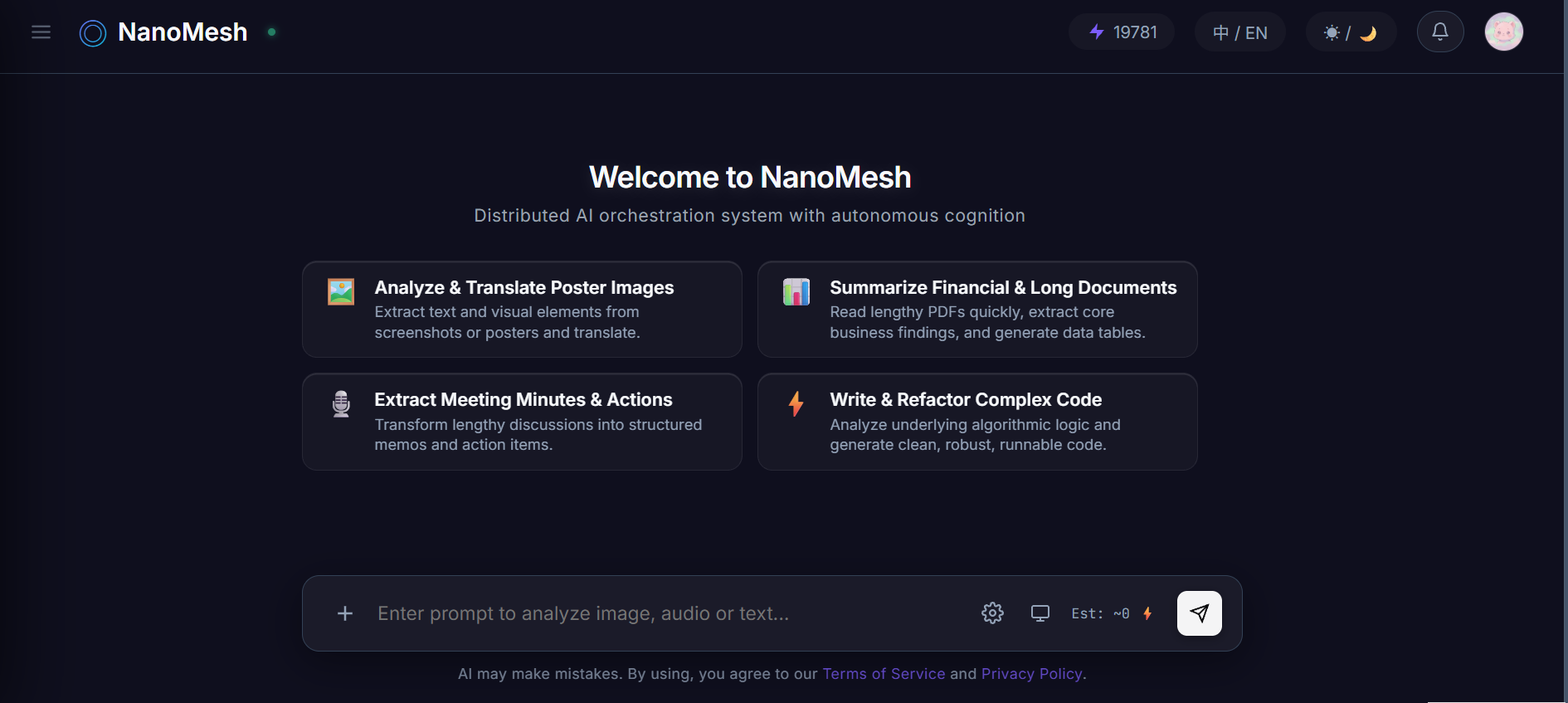
Figure 1.1: NanoMesh Interactive Console & Workstation Interface
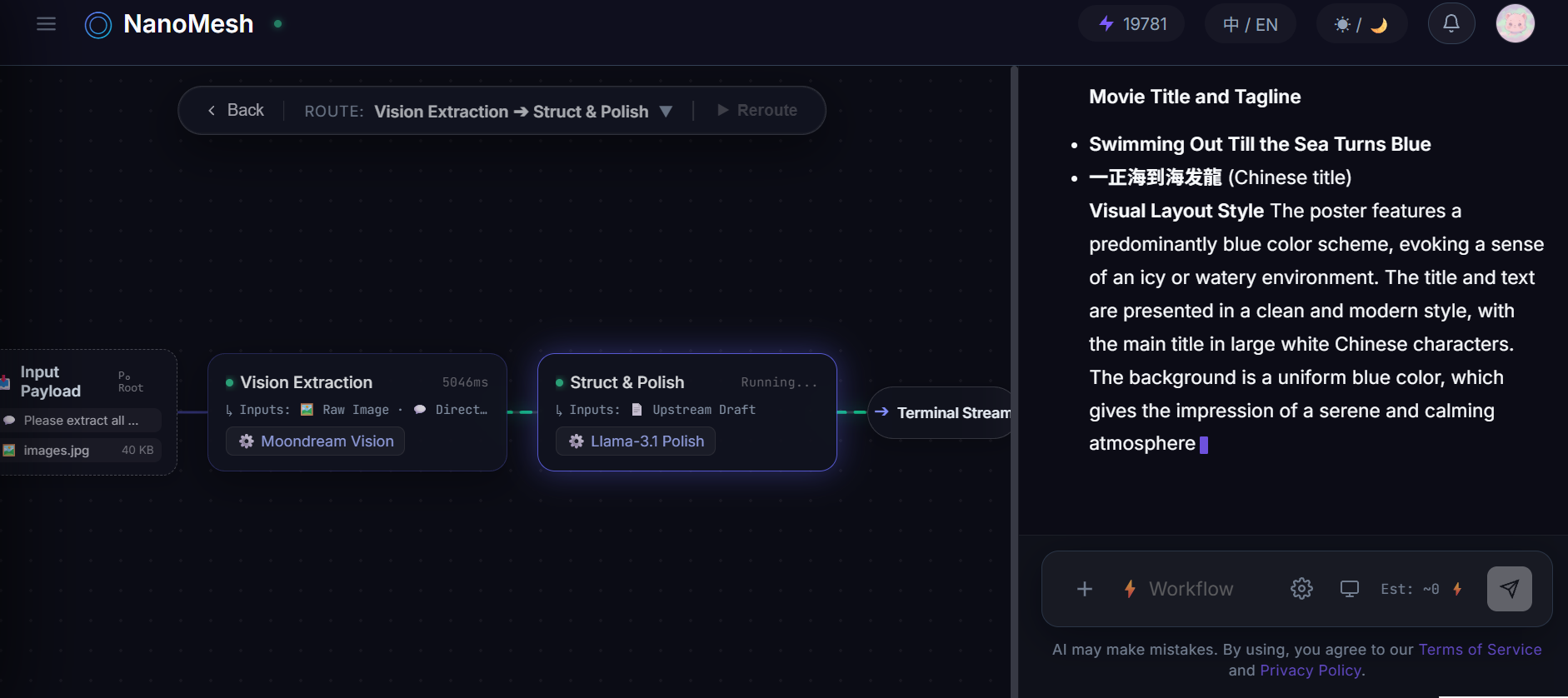
Figure 1.2: Real-Time DAG Execution Canvas & Multi-Turn State Machine
2. Architecture & Core Concepts
2.1 Tri-Tier Compute Model
- Lightweight Nodes (Client-Side): Executed locally in the user's browser using
@huggingface/transformerswith WebGPU or Wasm backends. Zero server compute consumption, low latency for deterministic subtasks. - Intermediate Nodes (Edge-Side): Lightweight routing, security classification, embedding generation, and state machine coordination running on Cloudflare Workers.
- Heavyweight Nodes (Cloud-Side): Complex reasoning and multi-modal synthesis delegated to upstream model APIs.
2.2 Shift-Left Processing Pipeline
To minimize payload latency and gateway bandwidth:
- Document Parsing: Handled in-browser via WebAssembly /
pdf.jsfor PDF, DOCX, TXT, CSV, and Markdown. Extracted contents are populated asin_memory_text. - Image Optimization: Automated downsampling via HTML5 Canvas (maximum 2048px resolution, JPEG 0.85 compression), reducing raw asset size by 80%–90%.
- Text Normalization: In-memory text extracted from documents is truncated at 30,000 characters if exceeded.
- Direct Storage Integration: Assets requiring cloud persistence are uploaded directly to Cloudflare R2 storage using AWS SigV4 pre-signed PUT URLs.
3. Protocol Specification
3.1 Unified Protocol Envelope
Every client interaction is packaged into a strongly typed, immutable request envelope:
interface UnifiedProtocolEnvelope {
  envelope_id: string;             // Global UUID
  session_id: string;              // Active session identifier
  round_index: number;             // Monotonically increasing round counter
  instruction_payload: string;     // Cleaned natural language user instruction
  assets_manifest: AssetDescriptor[]; // Multi-modal asset metadata
  constraint_context: {
    target_language: string;       // Preferred output language ('zh' | 'en' | 'auto')
    output_style: string;          // Output format ('concise' | 'detailed' | 'structured')
  };
  metadata: {
    client_timestamp: number;      // Epoch timestamp in milliseconds
    char_count_total: number;      // Character count of the instruction
    estimated_input_tokens: number;// Estimated token consumption
    has_new_upload: boolean;       // Indicates if new assets were attached this round
    new_upload_modalities: string[];// Modality types of newly attached assets
  };
}
3.2 Asset Descriptor
interface AssetDescriptor {
  asset_id: string;                // Unique asset fingerprint
  modality: 'image' | 'audio' | 'text_doc' | 'tabular' | 'code' | 'pdf';
  mime_type: string;               // Original MIME type
  file_size: number;               // File size in bytes
  r2_key: string | null;           // Remote R2 object key
  in_memory_text: string | null;   // Deconstructed plain text or Markdown table
  in_memory_data: string | null;   // Optional base64 inline representation
  consumed: boolean;               // State cursor indicating upstream consumption
  source_digest: string;           // SHA-256 integrity digest
  is_new: boolean;                 // Indicates whether uploaded in current round
  filename: string;                // Original file name
}
Note: If a user submits a query without attachments, the gateway wraps the raw instruction into a virtual text asset to maintain DAG modality consistency.
4. Model Arbitration & Routing Pipeline
The routing pipeline implements a three-stage arbitration algorithm:
[ Input Request ]
        │
        ▼
┌────────────────────────────────────────────────────────┐
│ Stage 1: Security Audit & Hard Filtering               │
│ - Shadow String Canonicalization (Unicode NFKC)        │
│ - Heuristic Pattern Sniffing                           │
│ - JEV Safety Binary Classification (Clef-Flash)        │
│ - Subsistence Law Template Filtering                   │
└────────────────────────────────────────────────────────┘
        │
        ▼
┌────────────────────────────────────────────────────────┐
│ Stage 2: JEV Scoring & Role Competence Resolution      │
│ - Candidate Template Scoring via Workers AI            │
│ - Fast-Failed Sentinel Check                           │
│ - Competence Law: Modality & Tag Intersection          │
│ - Dynamic Tag Fallback & Compensation Prompt Injection │
└────────────────────────────────────────────────────────┘
        │
        ▼
┌────────────────────────────────────────────────────────┐
│ Stage 3: Semantic Anchor Matching & Traffic Shaping    │
│ - Dense Vector Embedding via @cf/baai/bge-m3           │
│ - Cosine Similarity against Model Anchors              │
│ - Ultimate Scoring Formula with Quadratic Penalty      │
│ - Instantiation of Primary (Top 1) & Standby Models    │
└────────────────────────────────────────────────────────┘
4.1 Stage 1: Security Audit and Hard Filtering
- Shadow String Preprocessing: Strips zero-width characters, control codes, spaces, and punctuation; applies Unicode NFKC normalization and case folding.
- Heuristic Sniffing: Inspects patterns for unauthorized exploits, credential theft, denial-of-service tools, and destructive instructions. Benign queries pass immediately (0ms). High-risk red lines (e.g., CSAM, physical violence) are blocked directly.
- JEV Safety Bypass Classification: Suspicious patterns are evaluated using
@cf/cloudflare/clef-flashbinary classification (is_malicious: noul) to distinguish genuine threats from defensive or academic inquiries. - Hard Model Filtering: Discards models failing any of the following constraints:
- User rating $R_m < 1.0$
- Active concurrency $> 300$ or active connections $\ge$ maximum concurrency limit
- Context window $<$ estimated token requirement
- Model status $\neq$
'active' - Client preferences (disables
inference_target === 'browser'if local inference is toggled off)
- Subsistence Law: Filters candidate DAG templates based on user asset modalities: $${ \text{Head In-Modalities} } \subseteq A_{\text{user}} \subseteq { \text{Head In-Modalities} } \cup { \text{Tail In-Modalities} }$$ In single-node DAGs ($\text{in} = 0, \text{out} = 0$), this enforces exact equivalence: $A_{\text{user}} \equiv N_{\text{in}}$.
4.2 Stage 2: JEV Scoring and Role Competence
- Template Relevance Scoring: Evaluates candidate templates matching the Subsistence Law using
@cf/cloudflare/clef-flash. - Fast-Failed Sentinel: If the top template confidence score is below threshold ($\tau < 0.35$ or normalized score $< 25$), the gateway instantiates a
role_unreachablesentinel node, returning an advisory capability boundary notification without debiting user credits. - Role Competence Law: For each role in the selected template, candidates are resolved through set intersection:
- $\text{Role.in_modalities} \subseteq \text{Model.in_modalities}$
- $\text{Role.out_modalities} \subseteq \text{Model.out_modalities}$
- $\text{Role.requisition_tag} \subseteq \text{Model.tags}$
- Graceful Tag Downgrade: If the intersection yields an empty set, the scheduler steps down to the next priority tag and attaches a compensation prompt to maintain output consistency.
4.3 Stage 3: Semantic Anchor Matching & Traffic Shaping
Eligible models undergo quantitative ranking:
- Vector Semantic Matching: Generates user prompt embeddings via
@cf/baai/bge-m3and calculates cosine similarity against model scenario anchors: $$\text{sim} = \max_{a \in \text{Anchors}} \cos(\vec{v}_{\text{prompt}}, \vec{v}_a)$$ - Ultimate Scoring Formula:
$$S = \mu_0 + \alpha \cdot \max(0, \text{sim} - \tau) + \beta \cdot \frac{R_m}{5.0} - \gamma \cdot \left(\frac{C_{\text{active}}}{C_{\text{max}}}\right)^2$$
- $\mu_0 = 0.25$ (Generalist prior score; 0.0 for specialists)
- $\alpha = 0.50$ (Specialist activation boost weight)
- $\tau = 0.65$ (Specialist activation threshold)
- $\beta = 0.25$ (Quality rating weight, where $R_m \in [1, 5]$)
- $\gamma = 0.40$ (Quadratic concurrency penalty weight)
- Topology Instantiation: The highest-scoring candidate (Top 1) is selected as the Primary Model; Top 2 and Top 3 are preserved as Standby Models for manual client switching or automatic failover.
5. Execution State Machine & Streaming Protocol
5.1 Slicing and Consumption Rules
- Head Node ($\text{in} = 0, \text{out} > 0$): Claims unconsumed matching assets, sets
consumed = true. Masks user instruction payload (is_head_masked = true) to prevent perception bias. - Intermediate Node ($\text{in} > 0, \text{out} > 0$): Strictly consumes parent node outputs ($\sum \text{Out}_{\text{parent}}$). Does not access raw multi-modal assets.
- Tail Node ($\text{out} = 0$): Consumes all upstream node outputs, remaining unconsumed matching assets, user instruction, and constraint context to synthesize the final delivery artifact.
- Single-Node DAG ($\text{in} = 0, \text{out} = 0$): Directly receives both user prompt and assets.
5.2 Deterministic Node Fingerprinting
Nodes compute deterministic SHA-256 signatures for execution caching:
$$\text{Signature} = \text{SHA256}(\text{Role} + \text{ModelID} + \text{InputSourceDigest} + \text{InjectedPrompt})$$
Identical executions under low temperature ($T \le 0.2$) are served from the D1 database cache table (dag_execution_cache).
5.3 Server-Sent Events (SSE) Protocol
| Event Name | Description |
|---|---|
dag_plan |
Emits resolved DAG template metadata and node topology array. |
node_start |
Emits start of node execution with role, selected model, and target device. |
client_exec_request |
Dispatches execution payload to browser for local WebGPU inference. |
text_chunk |
Streams incremental text chunks (including cache_hit flag). |
node_complete |
Signals node completion with duration, token metrics, and output artifact. |
dag_complete |
Signals completion of the entire DAG pipeline with final payload. |
security_blocked |
Emitted when a security violation is detected and blocked. |
capability_unreachable |
Emitted when user request exceeds system capabilities (Fast-Failed). |
dag_error |
Emitted when an unrecoverable execution error occurs. |
6. Multi-Turn Dialogue & Dynamic Task Trees
To prevent context bloat and hallucination, NanoMesh maintains a structured Session Asset Ledger rather than forwarding raw chat history:
[Session Asset Ledger]
1. Asset Inventory:
   - [Asset 1]: modality: image | filename: spec.png | round: 1
   - [Asset 2]: modality: text_doc | filename: api.md | round: 2
2. Branch Catalog:
   - [Branch main]: Topic: Architecture Design | Status: active
3. Current Focus:
   - Active Branch: [Branch main]
   - Latest Baseline Output: "System architecture defined..."
[User Instruction]: {currentPrompt}
The gateway routes subsequent interactions through a five-state convergence model:
                            User Submits Query
                                    │
               ┌────────────────────┴────────────────────┐
               ▼                                         ▼
     New Assets Uploaded                        No New Assets Uploaded
               │                                         │
       JEV Binary Choice                         JEV Four-Way Choice
      ┌────────┴────────┐               ┌────────┬───────┴────────┬────────┐
      ▼                 ▼               ▼        ▼                ▼        ▼
CROSS_FUSION      DETACH_RESET     ANCHOR_TAIL REBIND_ROOT   DETACH_RESET SWITCH_BRANCH
(Multi-Source)    (Independent)    (Refinement) (Re-inspect)  (New Task)   (Branch Switch)
- State A (
ANCHOR_TAIL): Instruction belongs to the active branch domain and its requirements are fully satisfied by the latest artifact summary. Logically strips raw media assets and appends a lightweight execution node to the active branch tail. - State B (
REBIND_ROOT): Instruction belongs to the active branch domain, but requests information uncaptured or lost in the downstream summary, necessitating re-examination of the branch's underlying raw multi-modal physical media. Re-mounts raw media assets, resetsconsumed = false, and routes to multi-modal perception workflows. - State C (
CROSS_FUSION): Joint analysis comparing newly uploaded media with historical context. Re-mounts historical + new assets (consumed = false). - State D (
DETACH_RESET): Orthogonal new task with zero semantic dependency on existing branches or assets. Clears historical context and initializes an isolated net envelope. - State E (
SWITCH_BRANCH): Instruction departs from the active branch domain and targets an inactive historical branch in the catalog. Structurally excludes self-loops (targets $B \in \text{Historical} \setminus { \text{Active} }$). Re-activates the target branch's focus and re-binds its root media assets if perceptual depth is required.
7. Client WebGPU Runtime
NanoMesh embeds an in-browser inference engine driven by @huggingface/transformers (v3.8.1):
- Model Endpoint:
onnx-community/SmolLM2-135M-Instruct-ONNX-GQA - Model Footprint: 135M parameters; Q4 quantized download size $\approx 82\text{ MB}$.
- Hardware Acceleration: Probes WebGPU with
shader-f16/q4f16precision; automatically falls back to WebAssembly SIMD CPU execution if WebGPU is unavailable. - Compatibility Polyfill: Integrates
@petamoriken/float16to ensure compatibility across older Chromium mobile kernels. - Inference Configuration:
do_sample:truetemperature:0.6top_p:0.9repetition_penalty:1.25max_new_tokens:384
- Output Sanitization: Cleans chat template tokens (
<|im_start|>,System:) in real time.
8. Security, Rate Limiting & Quotas
8.1 Sanitization and HTTP Security
- DOMPurify Sanitization: All rendered Markdown outputs are sanitized through
DOMPurify 3.1.6insidesafeRenderMarkdown(). Strips<script>,<iframe>,<object>,<form>elements and inline event attributes (onerror,onload,onclick). - HTTP Security Headers: Injects
X-Content-Type-Options: nosniffacross all API responses.
8.2 Sliding-Window Token Bucket Limiter
Implemented via an in-memory map within Cloudflare Worker isolates:
- Bucket Capacity: 3 tokens (burst tolerance for immediate follow-ups).
- Refill Interval: 1 token per 5 seconds (~12 requests/minute steady state).
- Rate Limit Response: Returns HTTP 429 with
Retry-After: N. - Client Cooldown: Displays an interactive cooldown countdown modal (
#rate-limit-modal). Preserves user input in the chat box and enables resumption once the countdown finishes.
8.3 Upload Quotas
- File Count Limit: Maximum 5 files per interaction (
MAX_FILES = 5). - Total Payload Limit: Aggregate file size capped at 20MB (
MAX_TOTAL_SIZE = 20MB). - Single File Hard Limit: Cloud direct upload limit capped at 25MB (
MAX_CHAT_FILE_SIZE = 25MB). - Balance Protection: Users with
credits <= 0are blocked from file pre-signing and chat submission (HTTP 403 / modal alert).
9. Billing and Operations
- Registration Bonus: 100 ⚡ initial compute credits upon account creation.
- Two-Way Referral System: Referrers receive 50 ⚡ per referral. Referred users receive 100 ⚡ (initial bonus) + 50 ⚡ (referral reward) = 150 ⚡ total.
- Ledger Audit: All transactions, credit consumption, and redemptions are recorded in D1 table
credit_ledger. - Administrative Console (
/admin.html):- Real-time model configuration, concurrency controls, and status toggles.
- Voucher creation, activation, and batch invalidation.
- System notification broadcast dispatch.
10. Getting Started & Deployment
10.1 Prerequisites
- Node.js v18+
- Cloudflare Wrangler CLI
- Cloudflare D1 Database & R2 Bucket
10.2 Configuration
Create .dev.vars in the project root directory:
JWT_SECRET=your-secure-jwt-secret
GITHUB_CLIENT_ID=your-github-oauth-client-id
GITHUB_CLIENT_SECRET=your-github-oauth-client-secret
GOOGLE_CLIENT_ID=your-google-oauth-client-id
GOOGLE_CLIENT_SECRET=your-google-oauth-client-secret
FRONTEND_URL=https://your-domain.com
Configure wrangler.toml bindings:
name = "nanomesh"
main = "src/index.ts"
compatibility_date = "2024-09-23"

[[d1_databases]]
binding = "DB"
database_name = "nanomesh-db"
database_id = "your-database-id"

[[r2_buckets]]
binding = "R2"
bucket_name = "nanomesh-assets"

[ai]
binding = "AI"
10.3 Installation and Deployment
# Install dependencies
npm install

# Deploy to Cloudflare Workers
npm run deploy
简体中文
1. 项目概述
NanoMesh 是一套针对异构微模型与多模态任务调度的自适应分布式编排系统。系统将用户的多模态指令编译为可编辑的有向无环图(DAG),并在多轮交互中自适应维护有记忆的任务演化树。
系统构建了三层算力拓扑网络:
- 端侧轻节点:运行于浏览器内的 WebGPU / WebAssembly 微模型推理;
- 边缘中节点:部署于 Cloudflare Workers 的无服务器分布式网关与状态机;
- 云端重节点:接入上游大语言模型 API 执行高复杂度生成任务。
                                  [ 用户交互指令 ]
                                         │
                                  [ 统一协议信封 ]
                                         │
           ┌─────────────────────────────┼─────────────────────────────┐
           ▼                             ▼                             ▼
     [ 端侧轻节点 ]                [ 边缘中节点 ]                [ 云端重节点 ]
 浏览器 WebGPU/Wasm 本地推理     Cloudflare Workers 网关调度     上游大模型 API 直答
   (SmolLM2-135M-ONNX)           (安全审计与状态机流转)         (重度逻辑综合交付)
1.1 系统界面与实时 DAG 编排画布
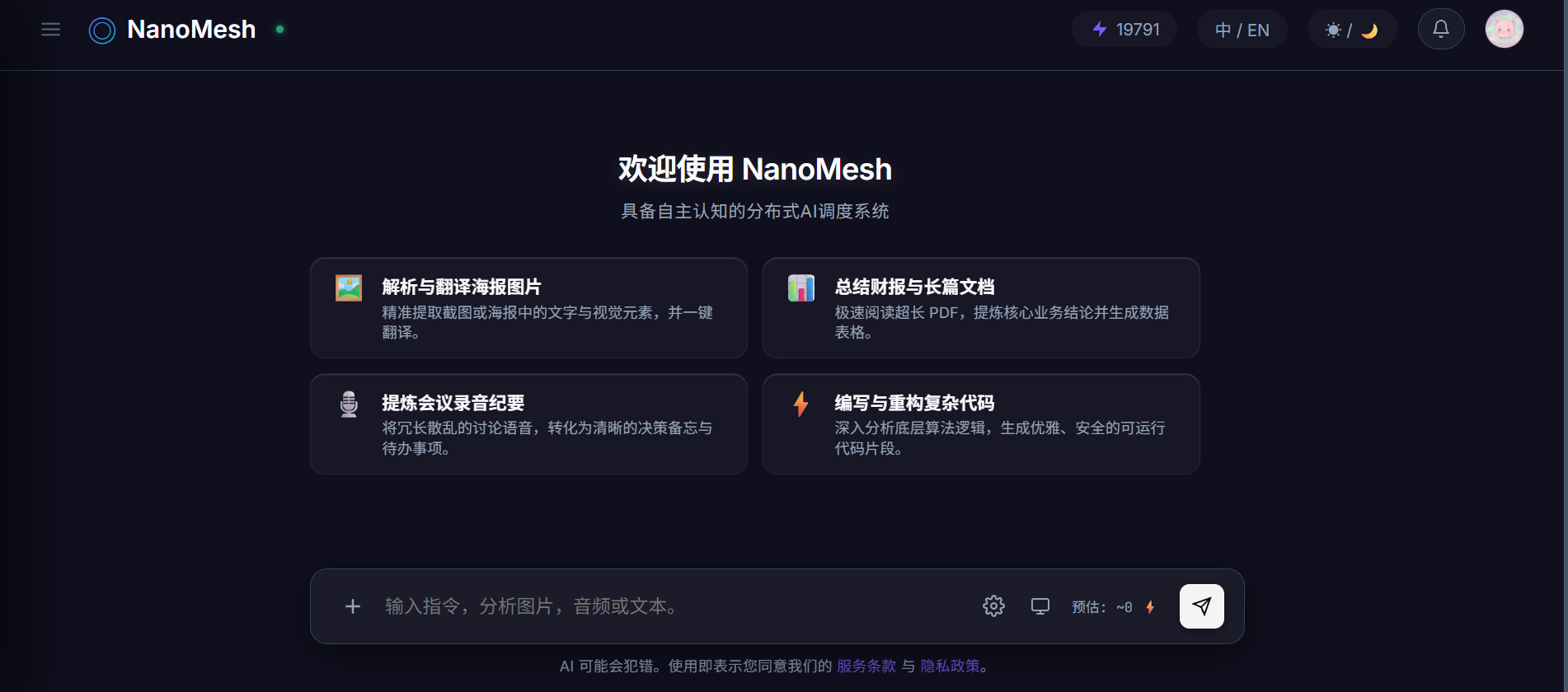
图 1.1: NanoMesh 交互控制台与多模态工作区
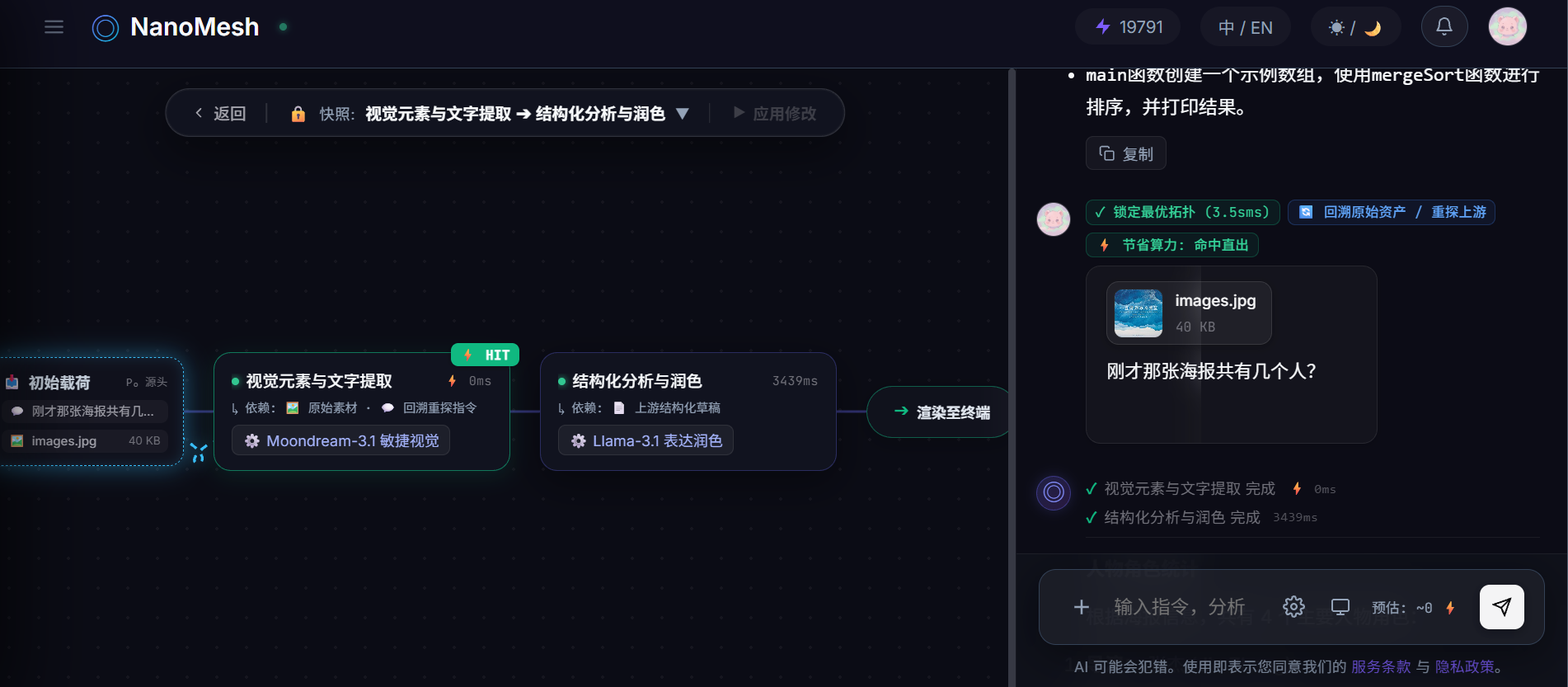
图 1.2: 实时 DAG 编排画布与多轮意图溯源状态机
2. 架构设计与核心机制
2.1 三层算力拓扑
- 轻节点(浏览器侧端推理):基于
@huggingface/transformers,直接调用客户端 GPU(WebGPU)或 CPU(WASM SIMD)运行,不消耗云端算力,保障基础处理时延与隐私隔离。 - 中节点(边缘分布式计算):基于 Cloudflare Workers 执行安全审计、向量嵌入匹配、模板评分及 DAG 状态机调度。
- 重节点(云端模型直答):处理需要大参数量支撑的复杂代码生成、多模态综合推理等重任务。
2.2 计算左移处理管线
为降低传输等待时间与网关计算压力,预处理全面左移至客户端执行:
- 文档就地解析:浏览器端使用 WebAssembly /
pdf.js直接解析 PDF、DOCX、TXT、CSV、Markdown 等文档,提取为in_memory_text纯文本或表格流。 - 图像自适应降采样:客户端通过 HTML5 Canvas API 按比例缩减分辨率(最大 2048px,JPEG 0.85 质量压缩),在人眼无损前提下缩减 80%~90% 上传体积。
- 文本软限制截断:文档提取出的文本超过 30,000 字符时,就地自动截断并给予提示。
- 直连对象存储:对于需要持久化的多模态介质,通过网关签发 AWS SigV4 预签名临时 PUT URL,文件由浏览器直传 Cloudflare R2 存储桶。
3. 通信协议规范
3.1 统一协议信封 (UnifiedProtocolEnvelope)
客户端在发起调度前,将非结构化输入封装为强类型只读信封:
interface UnifiedProtocolEnvelope {
  envelope_id: string;             // 全局唯一信封 UUID
  session_id: string;              // 当前会话 Session ID
  round_index: number;             // 当前会话轮次序号 (从 1 递增)
  instruction_payload: string;     // 清洗后的自然语言文本提示词
  assets_manifest: AssetDescriptor[]; // 关联多模态资产清单
  constraint_context: {            // 客户端请求的环境约束上下文
    target_language: string;       // 偏好输出语言 ('zh' | 'en' | 'auto')
    output_style: string;          // 输出风格 ('concise' | 'detailed' | 'structured')
  };
  metadata: {                      // 运行时元数据
    client_timestamp: number;      // 客户端发起的毫秒时间戳
    char_count_total: number;      // 提示词字符数
    estimated_input_tokens: number;// 预估消耗 Token 量
    has_new_upload: boolean;       // 本轮是否包含新引入资产
    new_upload_modalities: string[];// 本轮新引入资产的模态列表
  };
}
3.2 资产描述符 (AssetDescriptor)
interface AssetDescriptor {
  asset_id: string;                // 资产唯一指纹 ID
  modality: 'image' | 'audio' | 'text_doc' | 'tabular' | 'code' | 'pdf';
  mime_type: string;               // 原始 MIME 类型
  file_size: number;               // 字节大小
  r2_key: string | null;           // R2 寻址指针(若需云端存储)
  in_memory_text: string | null;   // 就地解构提取出的纯文本 / Markdown
  in_memory_data: string | null;   // Base64 短内联数据(可选)
  consumed: boolean;               // 状态游标:是否已被 DAG 某个上游节点独占消费
  source_digest: string;           // 资产完整性哈希指纹
  is_new: boolean;                 // 是否为本轮对话新上传的资产
  filename: string;                // 文件名
}
说明:若用户提交时未挂载任何附件,网关自动将提示词虚拟为文本资产挂载入资产清单,保证 DAG 模态匹配规则的一致性。
4. 模型仲裁与路由算法
系统采用三步仲裁法确定执行拓扑:
[ 用户输入请求 ]
       │
       ▼
┌────────────────────────────────────────────────────────┐
│ 第一步:安全审计与硬筛选                               │
│ - 影子字符串标准化 (Unicode NFKC 压平)                 │
│ - 启发式风险模式嗅探                                   │
│ - JEV Safety 旁路二元决策 (@cf/cloudflare/clef-flash) │
│ - 基于“温饱规则”的候选模板筛选                        │
└────────────────────────────────────────────────────────┘
       │
       ▼
┌────────────────────────────────────────────────────────┐
│ 第二步:JEV 评分与胜任力解析                           │
│ - Workers AI 候选模板胜任度打分                        │
│ - Fast-Failed 边界探针判定                             │
│ - 胜任定律:输入/输出模态与岗位标签交集运算            │
│ - 岗位标签降级策略与补偿 Prompt 注入                   │
└────────────────────────────────────────────────────────┘
       │
       ▼
┌────────────────────────────────────────────────────────┐
│ 第三步:锚点向量匹配与流量整形                         │
│ - @cf/baai/bge-m3 提取多语言密集语义向量               │
│ - 与模型高频场景锚点计算余弦相似度                     │
│ - 终极量化打分公式计算(含二次方并发惩罚)             │
│ - 实例化主执行模型 (Top 1) 与备选模型池 (Top 2 & 3)    │
└────────────────────────────────────────────────────────┘
4.1 第一步:安全审计与硬筛选
- 影子字符串预处理:剥离零宽字符与不可见格式控制符,执行 Unicode NFKC 标准化,压平空白与标点符号,统一转小写。
- 启发式嗅探打标:对恶意代码、未授权渗透、网络拒绝服务工具及凭据窃取等风险特征进行模式扫描。常规良性请求 0ms 直接放行;高危红线(如违禁暴力)直接熔断阻断。
- JEV Safety 旁路拦截:仅对命中可疑特征的输入,调用
@cf/cloudflare/clef-flash执行is_malicious: noul二元分类,区分实际恶意利用与良性安全防护配置。 - 模型硬筛选:从元数据库剔除不符合以下条件的模型:
- 综合评分 $R_m < 1.0$;
- 实时并发数 $> 300$ 或当前并发达到自身上限(满载);
- 上下文窗口容量小于当前预估所需 Token;
- 模型状态非激活(
status !== 'active'); - 满足客户端本地推理偏好(若用户开启“不使用本地模型推理”,屏蔽
inference_target === 'browser')。
- 温饱规则(模板收敛): $${ \text{头节点输入模态} } \subseteq A_{\text{用户资产}} \subseteq { \text{头节点输入模态} } \cup { \text{尾节点输入模态} }$$ 对于单节点 DAG($\text{in} = 0, \text{out} = 0$),强制等价收敛:$A_{\text{用户资产}} \equiv N_{\text{输入模态}}$。
4.2 第二步:JEV 评分与岗位胜任力
- 候选模板评估:调用
@cf/cloudflare/clef-flash对满足温饱定律的候选模板进行打分评估。 - Fast-Failed 机制:若最高模板匹配得分低于置信阈值($\tau < 0.35$ 或标准分 $< 25$),直接装配
role_unreachable单节点,以 0 算力消耗返回能力边界建议面板。 - 胜任定律交集运算:从模板提取各个岗位,对候选模型库执行交集筛选:
- 岗位输入模态 $\subseteq$ 模型输入模态;
- 岗位输出模态 $\subseteq$ 模型输出模态;
- 岗位征调标签 $\subseteq$ 模型标签。
- 标签平滑降级:若交集为空,按“岗位-标签”预置表向下检索备选标签重新匹配,并在该节点挂载补偿 Prompt 稳定输出。
4.3 第三步:锚点向量匹配与流量整形
在精选模型池内执行最终量化选拔:
- 语义向量匹配:调用
@cf/baai/bge-m3提取提示词向量,与模型预设的高频场景锚点做批量余弦相似度计算: $$\text{sim} = \max_{a \in \text{Anchors}} \cos(\vec{v}_{\text{prompt}}, \vec{v}_a)$$ - 终极量化打分公式:
$$S = \mu_0 + \alpha \cdot \max(0, \text{sim} - \tau) + \beta \cdot \frac{R_m}{5.0} - \gamma \cdot \left(\frac{C_{\text{active}}}{C_{\text{max}}}\right)^2$$
- $\mu_0 = 0.25$(通才先验分;专才模型为 0.0)
- $\alpha = 0.50$(专才权重系数)
- $\tau = 0.65$(专才门控激活阈值)
- $\beta = 0.25$(综合评分权重,其中 $R_m \in [1, 5]$)
- $\gamma = 0.40$(二次方并发惩罚系数,负载接近满载时抑制分配)
- 拓扑实例化:评分第 1 名作为主执行模型(Primary Model);第 2、3 名写入备选模型池(Standby Models),供前端随时热切换或网关故障转移。
5. 执行状态机与流式协议
5.1 信封切片规则(不贪吃原则与提示词遮蔽)
- 首节点($\text{in} = 0, \text{out} > 0$):认领模态匹配且
consumed === false的资产,置位consumed = true。严格遮蔽用户主提示词(is_head_masked = true),避免下游语义污染。 - 中间节点($\text{in} > 0, \text{out} > 0$):严格仅接收所有父节点的汇总输出产物($\sum \text{Out}_{\text{parent}}$),不触碰主信封原始介质。
- 尾节点($\text{out} = 0$):接收上游汇总产物、剩余未被消费资产、用户原始提示词与环境约束,生成最终交付物。
- 单节点 DAG($\text{in} = 0, \text{out} = 0$):同时接收原始资产与提示词。
5.2 确定性节点指纹与缓存
各节点依据输入要素计算 SHA-256 哈希签名:
$$\text{Signature} = \text{SHA256}(\text{Role} + \text{ModelID} + \text{InputSourceDigest} + \text{InjectedPrompt})$$
在低采样温度($T \le 0.2$)下,通过 D1 表 dag_execution_cache 命中产物直接返回。
5.3 SSE 实时流式事件协议
| 事件名称 | 描述 |
|---|---|
dag_plan |
广播征调模板元信息与 DAG 拓扑节点结构数组。 |
node_start |
广播开始执行的节点序号、岗位名称、选中模型及设备目标。 |
client_exec_request |
当节点调度至浏览器本地时,向前端派发本地推理指令 payload。 |
text_chunk |
尾节点流式输出文本增量 Token(附带 cache_hit 标识)。 |
node_complete |
单个节点执行完成,回传耗时、Token 统计与产物。 |
dag_complete |
整个 DAG 编排图执行完毕,推送最终综合交付物。 |
security_blocked |
触发安全策略拦截时推送。 |
capability_unreachable |
触发能力边界不可达(Fast-Failed)时推送。 |
dag_error |
发生不可恢复的执行异常时推送。 |
6. 多轮交互与动态任务树
网关不盲目透传整段历史,而是维护一份结构化的“会话事实账本”:
【会话事实账本】
1. 资产原件介质表:
   - [资产 1]: 模态: image | 文件名: spec.png | 引入轮次: 第 1 轮
   - [资产 2]: 模态: text_doc | 文件名: api.md | 引入轮次: 第 2 轮
2. 任务树分支目录:
   - 【分支 main: 初始系统分析】 状态: 活跃分支
3. 当前活跃焦点:
   - 当前正在进行的分支: 【分支 main】
   - 当前分支最新产物基底: "系统架构定义已完成..."
[用户最新指令]: {currentPrompt}
JEV 依据上下文进行五状态收敛判定:
                            用户在聊天框发送指令
                                     │
               ┌─────────────────────┴─────────────────────┐
               ▼                                           ▼
      本轮包含新上传附件                           本轮无新上传附件
               │                                           │
         JEV 二选一判定                              JEV 四选一判定
       ┌───────┴───────┐                 ┌────────┬────────┴────────┬────────┐
       ▼               ▼                 ▼        ▼                 ▼        ▼
 CROSS_FUSION    DETACH_RESET       ANCHOR_TAIL REBIND_ROOT   DETACH_RESET SWITCH_BRANCH
 (新旧融合对比)  (独立全新任务)       (轻量修饰)  (回溯重探)    (新独立任务) (历史分支切换)
- 状态 A (
ANCHOR_TAIL):指令属于当前活跃分支脉络,且所需事实信息完全由当前最新产物基底即可自洽满足。逻辑剥离原始大型媒体资产,以文本基底在活跃分支末端生长单步执行节点。 - 状态 B (
REBIND_ROOT):指令属于当前活跃分支脉络,但所需信息未在最新产物基底中包含或在下游抽象中已丢失,仅凭文字基底无法充分解答,必须穿透回溯底层原始多模态物理介质本身。全量复位该分支原始物理资产(consumed = false)并装配多模态感知工作流。 - 状态 C (
CROSS_FUSION):联合分析新上传资产与历史既有资产。全量重置资产消费游标(consumed = false)并在当前分支创建融合节点。 - 状态 D (
DETACH_RESET):指令开启完全独立的新任务,与当前活跃分支及所有历史分支无信息依赖。彻底清空历史挂载,构造独立的“零历史净信封”。 - 状态 E (
SWITCH_BRANCH):指令脱离当前活跃分支领域,转而依赖某一非活跃的历史分支。目标分支集合在图结构上严格排除当前分支自环(目标分支 $B \neq B_{\text{active}}$);切换焦点指针至目标分支,若目标分支关联多模态物理介质且需要溯源,连带复位该分支原始资产。
7. 端侧 WebGPU 微模型引擎
NanoMesh 内置基于 @huggingface/transformers (v3.8.1) 的浏览器端微模型推理引擎:
- 选型端点:
onnx-community/SmolLM2-135M-Instruct-ONNX-GQA - 模型规格:约 1.35 亿参数;Q4 量化下载体积约 82MB。
- 硬件适配:优先探测 WebGPU 与
shader-f16/q4f16精度;若不支持则自动降级为 Wasm SIMD CPU 执行。 - 环境垫片:针对部分移动端 Chromium 内核缺少原生
Float16Array的问题,引入@petamoriken/float16垫片。 - 运行采样参数:
do_sample:truetemperature:0.6top_p:0.9repetition_penalty:1.25max_new_tokens:384
- 输出过滤:实时过滤
<|im_start|>、System:等模板泄露标记。
8. 安全机制、频控与配额
8.1 渲染安全与响应头
- DOMPurify 净化管道:所有 Markdown 及模型流式输出均在
safeRenderMarkdown()内通过DOMPurify 3.1.6净化。移除<script>、<iframe>、<object>、<form>及onerror、onload、onclick等内联属性。 - 安全响应头:所有 API 响应注入
X-Content-Type-Options: nosniff。
8.2 边缘滑动窗口令牌桶限流
基于 Cloudflare Worker Isolate 内存 Map 实现的自适应令牌桶:
- 桶容量:3(支持短时快速重试)。
- 补充速率:每 5 秒补充 1 个令牌(稳态等效持续约 12 请求/分钟)。
- 超频响应:返回 HTTP 429 与
Retry-After: N响应。 - 交互保护:前端弹出自定义倒计时模态弹窗(
#rate-limit-modal),自动保留并回填用户输入文本,倒计时结束后解除锁定。
8.3 附件上传配额
- 文件个数限制:单次最多上传 5 个文件(
MAX_FILES = 5)。 - 总文件大小限制:多附件总大小上限 20MB(
MAX_TOTAL_SIZE = 20MB)。 - 单文件上传硬限制:单文件云端上传硬限制 25MB(
MAX_CHAT_FILE_SIZE = 25MB)。 - 算力余额保护:用户可用余额
credits <= 0时,禁止附件预签名与任务提交(HTTP 403 / 弹出充值提示)。
9. 财务与运营
- 注册体验包:新用户注册获得 100 ⚡ 初始算力包。
- 双向邀请机制:老用户成功邀请新用户,老用户获赠 50 ⚡,新用户获得初始 100 ⚡ + 邀请奖励 50 ⚡(共 150 ⚡)。
- 账目审计体系:D1 表
credit_ledger全量记录任务扣费、注册赠予、卡密充值与网格收益流水。 - 管理控制台 (
/admin.html):- 在线修改模型状态、并发上限与权重;
- 批量生成、查询与作废充值卡密;
- 向客户端派发全员或定向系统通知。
10. 快速部署
10.1 环境要求
- Node.js v18+
- Cloudflare Wrangler CLI
- Cloudflare D1 数据库与 R2 存储桶
10.2 环境变量配置
在项目根目录下配置 .dev.vars:
JWT_SECRET=your-secure-jwt-secret
GITHUB_CLIENT_ID=your-github-oauth-client-id
GITHUB_CLIENT_SECRET=your-github-oauth-client-secret
GOOGLE_CLIENT_ID=your-google-oauth-client-id
GOOGLE_CLIENT_SECRET=your-google-oauth-client-secret
FRONTEND_URL=https://your-domain.com
配置 wrangler.toml 绑定信息:
name = "nanomesh"
main = "src/index.ts"
compatibility_date = "2024-09-23"

[[d1_databases]]
binding = "DB"
database_name = "nanomesh-db"
database_id = "your-database-id"

[[r2_buckets]]
binding = "R2"
bucket_name = "nanomesh-assets"

[ai]
binding = "AI"
10.3 构建与部署
# 安装依赖
npm install

# 部署至 Cloudflare Workers
npm run deploy
License
Distributed under the MIT License. See LICENSE for more information.
讨论与反馈
登录后才能参与讨论
前往登录提 示
确定要删除这条评论吗?